

England is going to get half a million more trees. The question is what we are prepared to stop doing with the land underneath them.
The government has announced that 500,000 trees will be planted across England over the next 3 years, backed by £53 million for tree planting and another £26 million for local nature recovery strategies. The plans are partly a response to increasingly extreme weather. Trees provide shade during heatwaves and help land retain water when heavy rain arrives. Trees can reduce temperatures in cities by as much as 4°C, while a single mature tree can intercept 15,000 litres of water a year. More trees are good. More wetlands, meadows and restored river edges are good too. But restoring nature requires something all of them compete for: land. And Britain already has plenty of land. We have simply decided to use most of it for agriculture, particularly animal agriculture.
The government-commissioned National Food Strategy found that 85% of the farmland that feeds the UK, including land here and overseas, is used to rear animals. Meat, dairy and eggs provide just 32% of the calories we eat. The remaining 15% of that land, used to grow crops directly for humans, provides 68% of our calories.
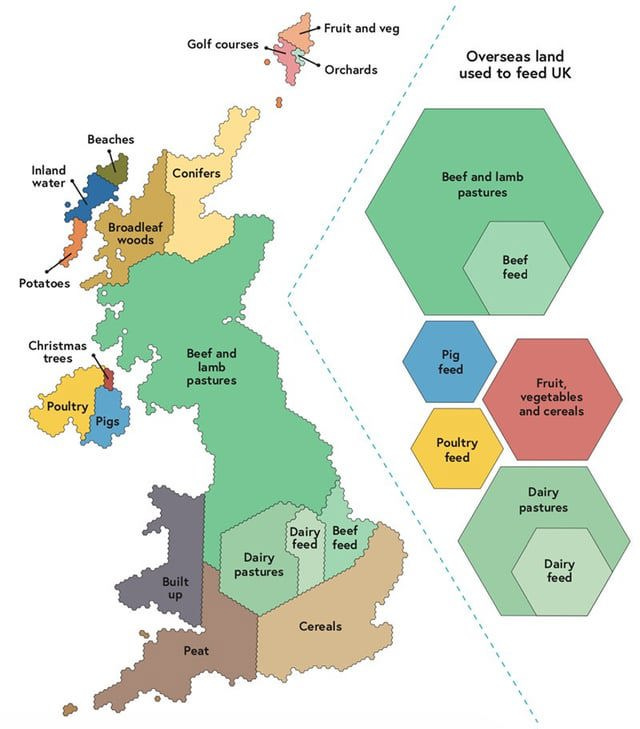
We talk about finding space for trees as though England is a crowded island where every available patch of soil is already performing some indispensable function. But enormous areas are devoted to producing relatively small amounts of food through animals.
The National Food Strategy calculates that growing plants for humans produces around 12 times more calories per hectare than using land for meat production. It describes reducing meat consumption as the single most effective lever available for improving the productivity of land. Even its relatively modest scenarios reveal how much land could be released. The report estimates that cutting meat consumption by 30%, increasing farm yields by 15% and halving food waste could allow the same number of calories to be produced using 30% less land.
Cutting meat and dairy consumption by one third by 2050, it says, could free a 5th of farmland. The report does not advocate veganism. Its recommendations leave animal agriculture firmly in place. But its own figures expose the opportunity being missed whenever environmental policy treats existing agricultural land use as inevitable.
We could plant trees while continuing to use vast areas of countryside to breed and feed animals. Or we could question why those animals are being bred in the first place.
The Vegan Land Movement is already taking the 2nd approach. Rather than trying to make animal agriculture slightly less destructive, it removes land from animal agriculture and returns it to biodiversity and wild species. Land previously used to farm animals is allowed to become habitat again.
That model connects two issues that are too often treated separately. Ending the exploitation of animals does not simply prevent individuals from being bred, confined and killed. It also releases land currently dedicated to maintaining that system. That land can become woodland. It can become wetland. It can become habitat for wild animals whose space has been squeezed by agriculture. It can store carbon, hold water and provide shade rather than being maintained primarily to produce animals or grow crops to feed them.
The government is right to plant 500,000 trees. It is right that local authorities and communities should have more support to restore nature. England has [lost more than 90% of its wetlands over the last century, and a changing climate makes restoring resilient ecosystems increasingly urgent.
But planting trees should not become another environmental policy that works around animal agriculture while refusing to confront the amount of land it consumes. If we want more room for forests, wetlands and wild animals, we already know where much of that room can come from.
We do not just need to plant trees.
We need to give the land back.