

New York City is preparing to ban horse-drawn carriages, with legislation expected to end the industry by June 2028. The proposed ban has the backing of Mayor Zohran Mamdani, City Council Speaker Julie Menin and the Central Park Conservancy. A vote is scheduled for 22 October, with the legislation expected to pass by a veto-proof majority.
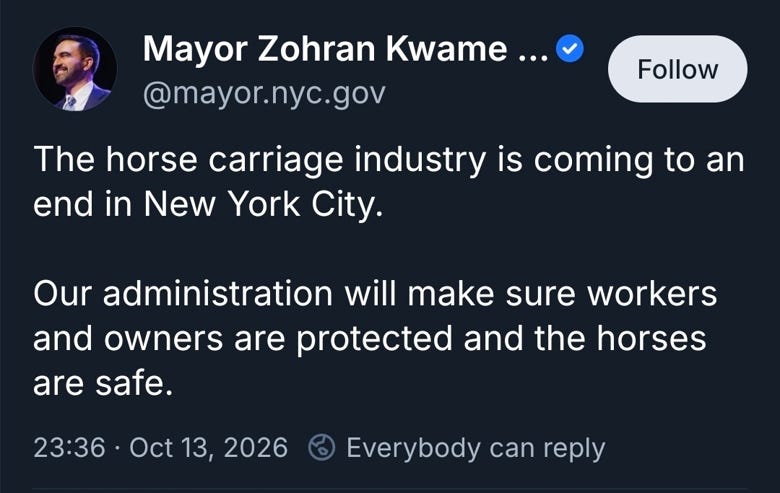
Writing on BlueSky, Mamdani said, “The horse carriage industry is coming to an end in New York City. Our administration will make sure workers and owners are protected and the horses are safe.”
The legislation, known as Romanch’s Law, would also provide career support for carriage drivers and require the horses to be rehomed. It’s a potentially enormous victory for animal advocates who have spent decades campaigning against the industry. Unfortunately, renewed momentum followed another tragedy. Earlier this year, 18-year-old tourist Romanch Mahajan died after falling from a carriage in Central Park. Menin subsequently described horse-drawn carriages as a growing public safety liability. But the horses have been paying the price for this tradition for considerably longer.
Earlier this year, Deniz collapsed and died in Central Park after eating a toxic plant while carrying passengers. In 2025, 15-year-old Lady collapsed and died while returning to her stable. In 2022, Ryder collapsed while working in extreme heat and was later euthanised.
Their deaths illustrate the dangers these animals face. But even if every horse survived, forcing them to pull tourists around a city would remain exploitation.
The question isn’t simply whether horse-drawn carriages can be made safer. It’s why horses should be subjected to this work in the first place. New York’s proposed ban recognises that the industry can end while supporting workers through the transition. And that raises an uncomfortable question for another city.
What’s Palma’s excuse?
The Mallorcan capital promised to replace horse-drawn carriages with electric alternatives by 2024. Two years after that deadline, horses are still pulling tourists through its streets, with no legally binding date for ending the practice. Meanwhile, nearby Alcúdia introduced electric carriages in 2025, and Muro is preparing to follow in 2027, subject to final approval. Palma cannot credibly argue that alternatives are impossible when neighbouring towns on the same island are already introducing them.
New York hasn’t passed its legislation yet, but the city is moving towards a concrete legal deadline. Palma made its promise years ago and continues relying on voluntary agreements. Neither city needs horses to pull tourists around. The technology to replace them exists, and so do arrangements to help drivers move into alternative employment.
What Palma needs is the political commitment to turn its overdue promise into law. More than 1,900 people have already signed our petition demanding Palma ban horse-drawn carriages.
Help us reach 2,000 signatures and demand a legally binding deadline.
banhdc.org 🚫🐴