

“Buy local” sounds like obvious environmental advice. A cow raised 5 miles away must be better for the planet than tofu made hundreds or thousands of miles away, right? Fewer food miles. Fewer lorries. Less pollution.
The problem is that this intuition gets the food system almost completely backwards. For most foods, where your food comes from matters far less than what your food actually is. And when we compare animal products with plant-based foods, the difference can be enormous.
Food miles aren’t the biggest problem
Transport produces emissions. Nobody is claiming otherwise. But for most foods, transportation represents a surprisingly small part of the total environmental footprint.
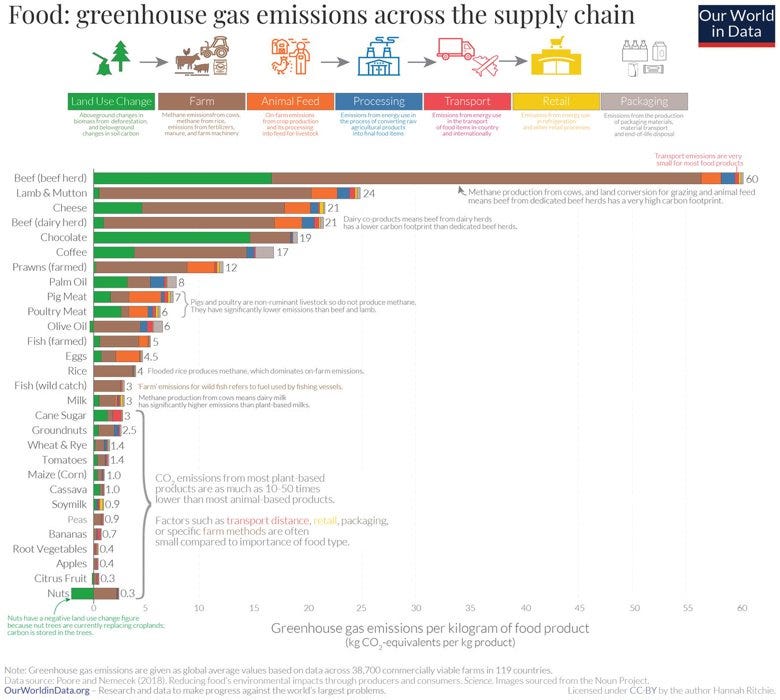
Our World in Data, drawing on the huge 2018 analysis by Joseph Poore and Thomas Nemecek covering more than 38,000 farms across 119 countries, reports that transport generally accounts for less than 10% of food-related emissions. For beef from beef herds, it accounts for around 0.5%. That means almost all the climate damage has already happened before the flesh ever gets anywhere near a supermarket.
The animals need land. They need food. Crops are grown to feed them. Forests and other habitats can be cleared for grazing or feed production. Cows produce methane. Manure releases greenhouse gases. Fertilisers are used. Energy is consumed. Moving the final product from one place to another is only one small piece of a much bigger system.
A review published in the Proceedings of the Nutrition Society reached much the same conclusion. It found no generalisable or systematic environmental or health advantage to choosing local food over non-local food and even identified situations where local production could perform worse.
This is the problem with “food miles” as a shortcut. Distance is easy to understand. Production systems are messier. But easy doesn’t mean important.
A local cow is still a cow
The difference between foods is staggering. According to the figures presented by Our World in Data, producing one kilogram of beef generates around 60 kilograms of CO2-equivalent greenhouse gases. Peas generate around 1 kilogram. Lamb and cheese both exceed 20 kilograms. Pork is around 7. Poultry around 6.
Plant foods overwhelmingly sit towards the bottom of the emissions table.
So imagine two meals. One contains beef raised on a farm just down the road. The other contains plant foods transported hundreds or even thousands of miles. The local label does not magically erase methane, feed production, land use or the enormous inefficiency involved in feeding crops to an animal and then eating the animal.
This is exactly why the scientific evidence can clash so dramatically with public perception.
A 2021 study examining beliefs about sustainable diets found that people strongly associated regional, seasonal and organic foods with sustainability, while underestimating the environmental benefits of meat-free diets. The researchers described a clear gap between consumer beliefs and scientific evidence. The same paper notes that agricultural production usually accounts for much more of a food’s environmental impact than transportation, and that regional production can sometimes even increase emissions because of differences in land use, productivity and soil emissions.
“Local” tells you where something was produced. It does not tell you whether producing it was efficient.
Then there is the land
Climate emissions are only part of the story. Animal agriculture uses an extraordinary amount of land.
Our World in Data reports that when grazing land and cropland used to grow animal feed are combined, around 80% of global agricultural land is used for meat and dairy production.
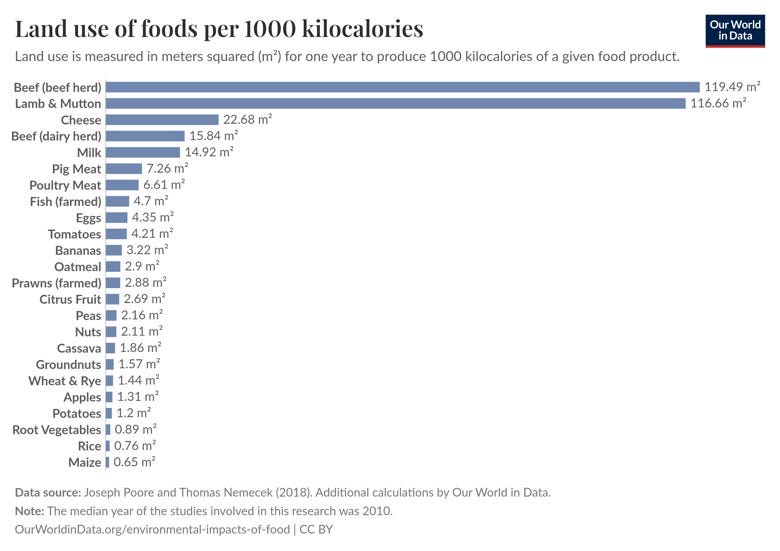
Beef and lamb can require roughly 50 to 100 times more land per calorie than plant-based alternatives. And here is where one of the strangest arguments against plant-based eating falls apart.
People sometimes imagine that replacing animal products with plants would require vast new areas of cropland. The opposite is true. We already grow enormous quantities of crops. We just feed a huge proportion of them to animals first.
Only around 48% of the world’s cereals are eaten directly by humans. Around 41% are used as animal feed. And animals are inefficient converters. For every 100 calories fed to a cow, only around 2 calories may eventually come back as beef. We could simply eat crops much closer to the source.
According to the Poore and Nemecek research, if the world adopted a plant-based diet, agricultural land use could fall from roughly 4.1 billion hectares to 1 billion hectares. That’s a reduction of around 75%. Land currently used for grazing and animal feed could instead be allowed to return to forests and other ecosystems, creating opportunities for both biodiversity recovery and carbon storage. That dwarfs the potential benefit of shaving a few hundred miles off your dinner.
There is one important exception
None of this means transport is irrelevant. Air freight can have a very high climate impact. Food transported by plane can produce around 50 times more emissions per tonne-kilometre than food transported by ship.
Highly perishable produce such as some berries, asparagus and green beans may be flown because they need to reach consumers quickly. But air freight represents only a tiny proportion of global food transport. Our World in Data puts it at about 0.16% of food miles.
Many foods people assume are flown across the world actually arrive by ship.
Even transporting avocados from Mexico to Britain, for example, was estimated to add only around 0.21kg CO2-equivalent per kilogram of avocados. So yes, avoiding air-freighted produce where practical can reduce your footprint. But don’t mistake the exception for the rule.
Local isn’t a climate get-out clause
There can be perfectly good reasons to support local food producers. Local supply chains may offer resilience. You may know more about how food is produced. Local farms may use environmental practices you want to support. But none of that makes locality a reliable proxy for sustainability. And it certainly doesn’t make locally produced animal products environmentally equivalent to plants.
A cow doesn’t stop producing methane because you can see the field from your window. The crops grown to feed animals don’t stop requiring land because the farm has a nice sign outside. The fundamental inefficiency of feeding plants to animals and then eating their bodies doesn’t disappear when the journey to the supermarket gets shorter.
If climate impact is what you’re trying to reduce, the science points overwhelmingly towards a much more important question than “How far did my food travel?”
Ask: “What am I eating?
Because imported beans can still beat local beef. And by an enormous margin.