Every time someone insists that veganism is “just a diet”, or that opposition to it is organic, spontaneous, and grounded in good faith disagreement, they are asking you to ignore how power actually operates.
An anonymous whistleblower has done what the meat industry has spent decades trying to prevent. They named the mechanism.
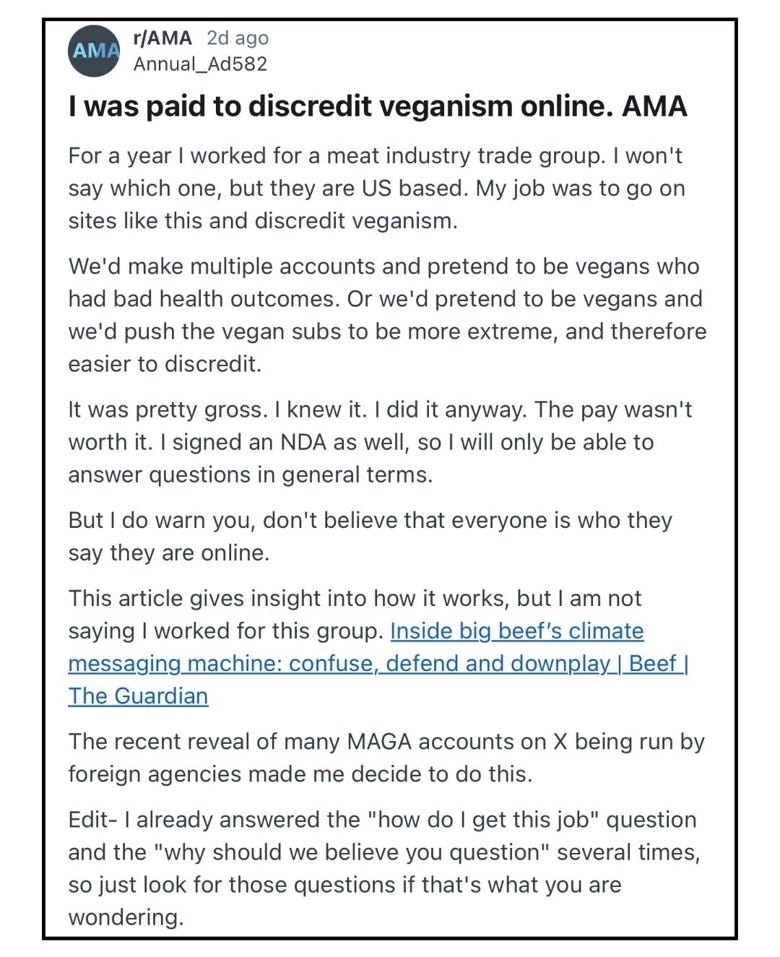
In a now-deleted Reddit AMA, the individual claimed they were paid by a US-based meat industry trade group to discredit veganism online. The rate was reportedly $17 an hour. The duration was a year. The job description was simple. Go on social platforms. Create multiple accounts. Undermine veganism by any means that worked.
This was not advocacy. It was not debate. It was not disagreement. It was paid disinformation.
According to the whistleblower, the strategy involved impersonating vegans who had allegedly experienced negative health outcomes, exaggerating or inventing nutritional harms, and deliberately pushing online vegan spaces toward caricature so they would be easier to ridicule. The goal was not to challenge arguments. It was to poison perception. And crucially, it worked precisely because it did not look coordinated.
One of the most revealing claims made in the AMA was that roughly half the accounts on certain Reddit threads discussing veganism were not genuine. Not confused individuals. Not former vegans with sincere grievances. Paid operatives, cycling accounts, recycling talking points, and simulating grassroots backlash.
This matters, because the meat industry’s power has never rested solely on production. It rests on narrative control.
Manufacturing doubt as a business model
None of this is new. It is simply newly confessed.
The tactics described mirror the same strategies used by tobacco companies, fossil fuel giants, and chemical manufacturers for decades. You do not need to prove your product is ethical, necessary, or safe. You only need to create enough doubt that people feel justified in continuing as they are.
According to the whistleblower, nutritional misinformation was a primary focus. Health claims are emotive, personal, and difficult for non-experts to verify. They also carry the added benefit of making veganism seem risky rather than principled.
Some of the claims were deliberately absurd. One colleague allegedly claimed veganism had caused them to develop OCD. Others invented vague but alarming deficiencies. These stories were not supported by evidence. They did not need to be. They only needed to be plausible enough to circulate.
The whistleblower admitted openly that data was cherry-picked and falsehoods were knowingly repeated. Crop deaths were a favoured angle. Not because the numbers were solid, but because they were unknowable. The absence of precise figures made exaggeration easy, and the ideological work was already done. If you can convince people that plants “kill too,” you can attempt to blur moral distinctions and walk away absolved.
The same logic applied to attacks on plant-based meat. Ingredients with long chemical names were framed as dangerous, exploiting widespread chemophobia. Never mind that water is a chemical, or that animal products are routinely treated with additives, antibiotics, and preservatives. Fear does not require consistency.
It requires repetition.
Fake outrage, real money
When asked whether the meat industry also funds influencers to promote all-meat diets and animal-based health trends, the whistleblower’s answer was blunt. Yes. “Big time yes.”
This aligns with what independent investigations have already shown. Industry-linked PR firms have worked to reframe scientific consensus, smear public health reports, and rehabilitate meat consumption as rebellious, natural, or masculine. The carnivore diet did not spread because the evidence supported it. It spread because it was profitable to promote confusion.
A 2023 Guardian investigation described this as “big beef’s climate messaging machine,” designed to confuse, defend, and downplay the environmental consequences of animal agriculture. That same machine now operates openly across social platforms, dressed up as authenticity and outrage.
And it is not limited to nutrition.
Research published earlier this year by Rooted Research Collective and The Freedom Food Alliance found that a significant proportion of online misinformation can be traced back to just 53 social media super-spreaders. Ninety-six percent of them monetise health misinformation in some form. This is not decentralised ignorance. It is an economy.
When DeSmog investigated how the meat industry responded to the EAT-Lancet report, they found PR firm Red Flag briefing journalists, think tanks, and influencers to frame it as radical, hypocritical, and elitist. The objective was not to engage with the science. It was to delegitimise it socially.
This is what narrative capture looks like.
“I knew it was gross. I did it anyway”
The whistleblower did not attempt to absolve themselves. They described the work as “pretty gross,” admitted they felt guilty, and said the pay was not worth it. They also signed an NDA, which is why the AMA was deliberately vague.
That guilt does not undo the harm. But it does confirm something animal advocates have been told repeatedly is paranoia. That much of the hostility toward veganism is not spontaneous. It is manufactured.
The whistleblower claimed they initially believed vegans were stupid. After doing the job, they said they respected them. Not because they stopped eating animals, but because they saw firsthand how much effort and money was poured into undermining them.
This matters, because veganism is not opposed because it is fringe. It is opposed because it threatens a system built on use.
Animal agriculture is responsible for nearly 60% of food-related emissions and up to a third of all human-caused greenhouse gases. It is a leading driver of deforestation, biodiversity collapse, water pollution, and food waste. None of this is controversial within the scientific literature. What is controversial is allowing that knowledge to disrupt business as usual.
Which is why more than 300 industrial agriculture lobbyists attended the most recent COP climate talks. More than the entire Canadian delegation. Raj Patel described COP30 not as a climate conference, but as a hostage negotiation.
That framing is not hyperbole. It is accurate.
Do not confuse silence for neutrality
Since the AMA, the whistleblower’s Reddit account has been deleted. Several social media posts covering the story have disappeared. Ladbible’s article is no longer accessible. The internet forgets selectively.
But archived threads remain. Patterns remain. And the underlying structure remains untouched.
The lesson here is not that “you can’t trust anyone online.” That is too shallow, and conveniently individualises what is a systemic problem.
The lesson is that when an industry’s survival depends on public confusion, it will pay to create it. When a justice movement threatens profit, it will be reframed as dangerous, extreme, unhealthy, or unhinged. Not because those claims are true, but because they are useful.
Veganism is not resisted because it lacks evidence. It is resisted because it challenges the moral legitimacy of using others as resources.
And that challenge is expensive to suppress.
So the next time you see yet another identical argument recycled in the comments. The next time a former vegan story sounds suspiciously rehearsed. The next time crop deaths or “chemicals” or fake masculinity panic appears on cue, remember this. Someone, somewhere, was paid to say it.
And that alone tells you which side threatens power.